Loading page
AI for Everyone – Free-to-Start AI Course
DeepLearning.AI
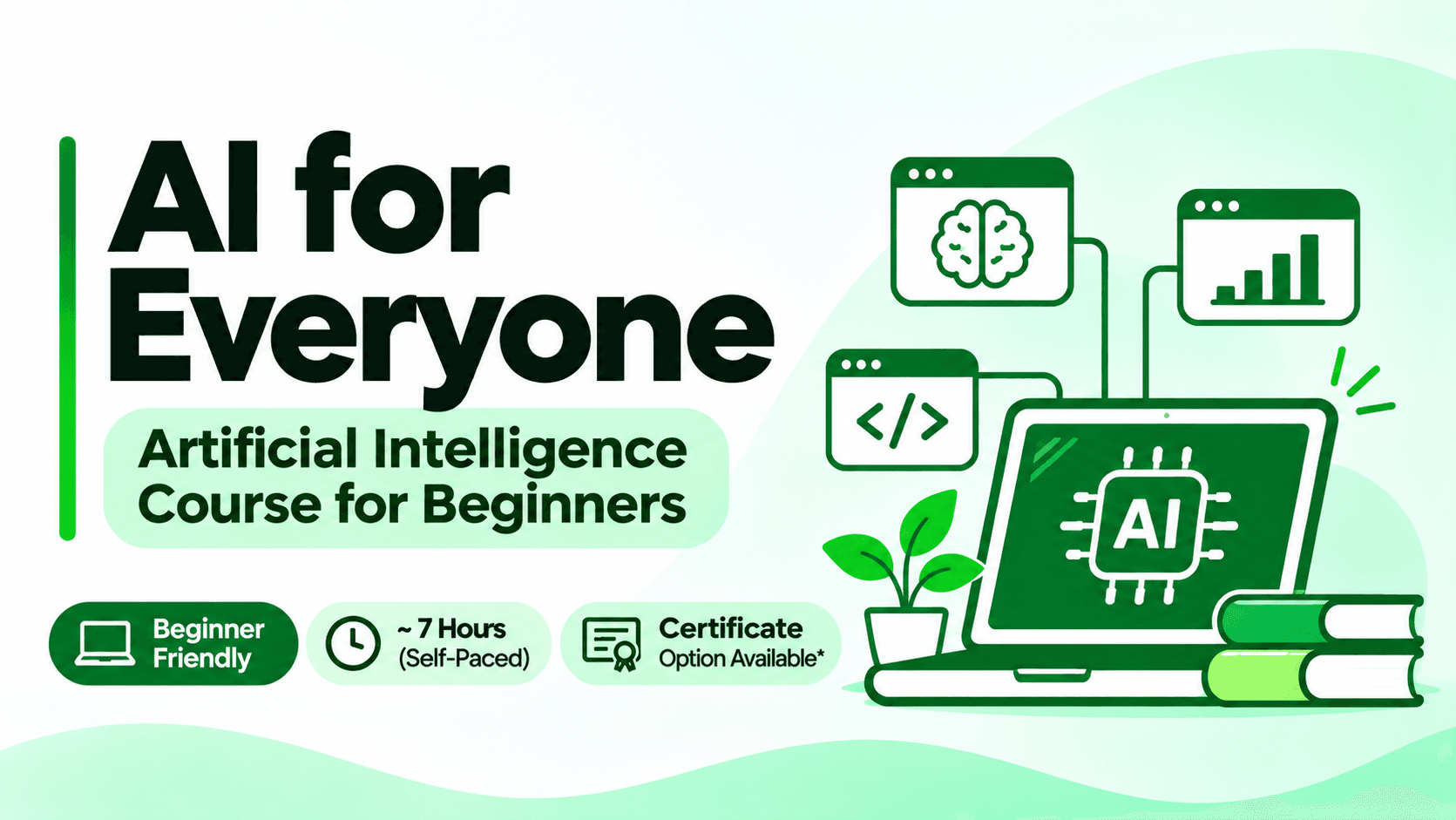
Core Details
- Mode: Online
- Duration: Approximately 7 hours
- Price: Course information is available for free; however, there may be paid certificate/enrollment possibilities. Confirm the current terms.
DeepLearning.AI allows you to learn artificial intelligence from scratch.Andrew Ng's AI for Everyone course is geared toward beginners. No prior programming experience is required.
HerCode Summary
AI for Everyone – by DeepLearning.AI
Artificial intelligence is transforming the way businesses function, products are generated, and individuals engage with technology. From recommendation systems and virtual assistants to healthcare applications and automated corporate operations, artificial intelligence is becoming an increasingly vital aspect of modern business. Understanding AI is no longer just for software engineers or data scientists. Students, recent graduates, business professionals, and others with no technical expertise can all benefit from understanding how this technology works.
DeepLearning offers an online course for beginners called AI for Everyone.AI is taught by Andrew Ng. The course teaches students the principles of artificial intelligence, machine learning, deep learning, and data science. Rather of focusing on programming or constructing machine learning models, it explains AI principles in layman's terms and helps students understand how AI projects are planned, developed, and executed in real-world enterprises.
The course is intended for those who want to grasp the capabilities and limitations of Artificial Intelligence before progressing to higher technical studies. It also describes how firms find possibilities to apply AI, how technical and non-technical teams communicate, and how AI technologies affect businesses and society.
What Will You Learn?
-
Participants in this course will gain a fundamental understanding of artificial intelligence and its practical applications.
-
Artificial Intelligence Fundamentals: Understand what AI is, how it works conceptually, and how it is applied in various industries.
-
Machine Learning: Discover how computers recognize patterns in data and utilize them to create predictions or judgments.
-
Deep Learning: Learn about deep learning and neural networks without requiring strong mathematics skills.
-
AI Capabilities and Limitations: Determine what AI systems can realistically accomplish and where they may not be appropriate.
-
Machine Learning Project Workflow: Understand the general steps involved in planning and developing machine learning projects.
-
Data Science Workflow: Learn how firms use data to uncover trends and make informed decisions.
-
AI Strategy: Learn how firms discover chances to use AI in their operations.
-
Responsible AI entails understanding the ethical and societal concerns involved with artificial intelligence.
Course curriculum
The curriculum is divided into four sections.
Module 1: What is artificial intelligence (AI)?
This session covers Artificial Intelligence and commonly used terms. Students investigate machine learning, deep learning, neural networks, and data science. It also teaches what machine learning can and cannot achieve, allowing beginners to form realistic expectations about AI technologies.
Module 2: Create AI Projects
Learners are introduced to the workflows used in machine learning and data science projects. This module describes how corporations identify problems that can be solved with AI, plan projects, and work with technical teams.
Module 3: Implementing AI in Your Company
This lesson focuses on how organizations employ artificial intelligence. Learners investigate AI applications, AI team roles, and how businesses establish strategies for incorporating AI into their operations.
Module 4: AI & Society
The third lesson covers AI's broader impact on society. AI-related bias, adversarial attacks, unsuitable AI applications, employment changes, and the significance of responsible AI development are among the topics discussed.
Who Should Take this Course?
-
This course is suited for students with both technical and non-technical backgrounds.
-
Engineering and computer science students are interested in AI.
-
College students are investigating machine learning and data science.
-
Fresh grads preparing for technological careers.
-
Beginners who want to comprehend AI without first learning to program.
-
Software developers are interested in AI's business applications.
-
Product managers, entrepreneurs, and business experts.
-
Non-engineering students are interested in learning about upcoming technology.
Eligibility criteria
-
This beginning course has no set degree, CGPA, academic %, or graduation year requirements.
-
Learners do not require prior knowledge with Artificial Intelligence, Machine Learning, Data Science, or Software Development. Enrollment is open to both technical and non-technical individuals.
Requirements
-
A computer, tablet, or smartphone with internet connection.
-
A legitimate account with the relevant learning platform.
-
A basic understanding of English is required to follow the classes.
-
Interest in learning about artificial intelligence.
-
Programming knowledge is not required.
-
Previous AI experience is not required.
-
Mathematics: No advanced math skills are necessary.
Course Duration and Learning Activities
The course covers roughly 7 hours of study material and allows for self-paced learning. It comprises training videos and graded assignments, depending on the enrollment level.
Learners are expected to view the classes, comprehend the principles, investigate the examples, and complete any applicable tests. They can have a flexible schedule and review the course material as needed.
However, it is critical to recognize that this is a conceptual introduction, not a practical AI engineering program. It does not replace the technical expertise needed to create AI applications or train machine learning models.
Students interested in becoming AI engineers should continue to study Python, mathematics, statistics, machine learning algorithms, deep learning frameworks, and real project development.
Certificate Information
Certificate availability and assessment access are determined by the enrollment option and learning platform. Before enrolling, learners should check the official course website for the most up-to-date credential requirements, pricing, and access conditions.
Skills You Can Develop
-
Artificial Intelligence Fundamentals
-
Machine Learning Concepts
-
Deep Learning Terminology.
-
Neural Network Fundamentals
-
Data Science Fundamentals
-
AI Project Planning
-
AI Strategy and Implementation
-
Responsible AI Awareness
-
Understanding AI's capabilities and limitations.
-
AI Applications for Business
Certificate Information
Certificate availability and assessment access are determined by the enrollment option and learning platform. Before enrolling, learners should check the official course website for the most up-to-date credential requirements, pricing, and access conditions.
How do I enroll?
Interested students should go to DeepLearning's official website.Visit the AI course page to evaluate the curriculum and registration choices.
The official course page is https://www.deeplearning.ai/courses/ai-for-everyone.
Provider: Deep Learning.AI
HerCode is an independent portal that provides educational opportunities and employment tools. DeepLearning offers and manages the course.AI and the related learning platform. Enrollment, course delivery, fees, assessments, and certificates are subject to the provider's policies.
Eligibility
- Open to learners with both technical and non-technical backgrounds.
- No specific degree or graduation year is necessary.
- There is no minimum CGPA or academic % required.- No previous AI or machine learning experience is necessary.
- No programming knowledge is necessary.
- Ideal for college students, recent grads, working professionals, and beginners.
Requirements
- Laptop, desktop, tablet, or phone.
- A stable internet connection.
- A valid account on the suitable learning platform.
- Basic English comprehension.- Interest in AI and new technologies.
- A willingness to finish the video classes and available tests.
Skills
- Understanding the fundamentals of AI and machine learning.
- Deep Learning Fundamentals: Neural Networks
- Data Science Fundamentals, AI Project Planning, and Machine Learning Workflows
- AI Strategy
- Responsible AI applications for business.
Important Dates
- Registration
- Ongoing – verify official page
- Course start
- Self-paced
How to Apply
How to Enrolll in AI For Everyone
Interested learners can access the course by following these steps:
- Go to the official [AI for Everyone course page] (https://www.deeplearning.ai/courses/ai-for-everyone/).
- Examine the course synopsis, curriculum, instructor bios, and accessible learning alternatives.
- On the official platform, select one of the various registration options.
- Create an account or sign in if necessary.
- Prior to proceeding, review all applicable fees and certificate requirements.
- Follow the platform's enrollment steps.
- Begin learning from the available online tutorials. Important: Course access, assignment availability, cost, and certificate eligibility may differ depending on the registration option chosen. Always check with the official course provider for the most up-to-date information.
Enrollment Link: https://www.deeplearning.ai/courses/ai-for-everyone.
Frequently Asked Questions
1: Is AI for Everyone appropriate for beginners?
Yes, AI for Everyone is intended for beginners who want to understand Artificial Intelligence without prior technical expertise or programming experience.
2. Do I need coding knowledge to enroll?
No, this is a nontechnical basic course. Students do not need Python, Java, or any other programming language to understand the course material.
3: Is this course appropriate for non-CS students?
Yes. Students with non-computer science backgrounds, as well as working professionals, can enroll. The course discusses AI topics without requiring a technical expertise.
4: Who teaches AI for Everyone?
Andrew Ng, the inventor of DeepLearning.AI and a well-known AI professor, teaches the course.
5. How long does it take to finish the course?
The course has about seven hours of learning material. Learners can progress at their own pace.
6: Is AI for Everyone fully free?
Don't assume that all enrollment, assessments, and certificates are free. The learning platform and registration option you choose determine the available access and pricing. For up-to-date information, visit the official course page.
7: Will I receive a certificate upon completion of the course?
The certificate's availability is determined on the enrollment option chosen and the platform's requirements. For up-to-date certificate conditions, see the official enrollment page.
8: Does this course cover practical AI development?
The course's primary focus is on comprehending AI ideas, project procedures, corporate applications, and societal impact. It is not a practical programming course for developing AI applications.
9. Will this course help me become an AI engineer?
It can help you learn the principles of AI, but it isn't enough to become an AI engineer. You will require more technical education in Python, mathematics, machine learning, deep learning, and practical AI projects.
Official Application Link
Official source: Deep Learning .AI
Last verified: 17 November 2026